How to Improve Your Investment Strategy Using AI Tools

A new era of data, technology, and intelligent automation has emerged in the world of investment. Artificial Intelligence (AI) is no longer just a catchphrase; it is now a useful tool that enables investors to make quicker, more intelligent decisions. AI is changing the way humans approach investing, from spotting hidden possibilities to controlling risk and automating portfolios.
The problem is that although AI systems are capable of processing massive volumes of data, they cannot take the place of human judgment or financial discipline. They improve it. Today’s successful investors employ AI tools to refine their strategy in addition to selecting quality stocks. This post will walk you through the process of using AI technologies to make better investment decisions while keeping your own judgment and objectives at the forefront.
1. Understanding AI’s Roles in Investing
Artificial Intelligence in investing refers to the use of machine learning, data analytics, and natural language processing to analyze financial information and make predictions. Traditional investing often relied on historical data and human analysis. AI, on the other hand, processes millions of data points — from stock prices and company reports to news and even social sentiment — in seconds.
AI tools identify patterns and relationships that are often invisible to the human eye. For instance, AI algorithms can detect early signs of volatility or forecast the potential impact of global events on certain sectors. This predictive power helps investors stay one step ahead.
In simple terms, AI transforms data into actionable insight, empowering investors to make decisions based on logic and evidence rather than emotion.
2. How AI Helps Investors Make Smarter Decisions
Decision fatigue is perhaps one of the major issues that investors face. There are thousands of stocks and an endless flow of news, and it is very difficult to make decisions that are rational and consistent. AI does this by filtering the noise and delivering the relevant insights.
AI-based analytics instruments can do the following: They can compare companies in the same industry, calculate risk levels, and even indicate the best times for going in or coming out. As an illustration, AI-powered platforms such as Kavout, Sentifi, or AlphaSense have the capability to analyze market data going back several years to find the trends that match your investment objectives.
Its main benefit is in being objective — a human can panic during a market dip, or get overexcited when stocks are rising, but AI doesn’t. It simply looks at the facts and the likelihoods. Such a data-driven way of doing things can save you from the error of impulsive buying and instead help you to concentrate on strategies that bring measurable results.
“Don’t Panic – Do This: Smart Moves Before the Market Drops” Learn More.
3. Popular AI Tools for Investment Research
Several AI tools have become popular among investors and financial analysts. Some examples are:
ChatGPT (OpenAI) – Useful for research summaries, stock comparisons, or creating investment insights from data.
AlphaSense – Leverages AI to read the company’s financial documents, analyst reports, and news to find the new openings.
Morningstar AI – Provides portfolio analytics, fund comparisons, and risk analysis based on data.
TradingView AI – Enables traders to automatically recognize technical chart patterns.
Wealthfront & Betterment – Robo-advisors that implement AI-driven algorithms for automated investing and rebalancing.
These tools make research less complicated and give investors the opportunity to make quick data-informed decisions. Nevertheless, knowing how to interpret the information is still very important – AI provides you with data, but the decision is still yours.
4. Using AI for Portfolio Optimization
Portfolio optimization is fundamentally about balancing risk with return. AI elevates this idea to a whole new level. AI algorithms, through the analysis of your portfolio’s past performance, volatility, and diversification, can be the ones to dispatch the finest tweaks to your portfolio.
As an instance, robo-advisors such as Betterment and Wealthfront are constantly scrutinizing market fluctuations and, as a result, they rebalance portfolios automatically to align with your target allocation. In addition, they also take into account elements like risk tolerance, investment horizon, and tax efficiency.
Besides that, AI can be employed to create various market situations in the future, thereby giving investors the opportunity to test their portfolio performance under different conditions. Such forward-looking analysis was previously only available to institutional investors. Now, however, anyone can access it as long as they have the right tools.
💡 Best Investment Tip
Stop following every AI-powered stock or tool that comes your way. AI is great for market analysis but not for trend speculation. The cleverest investors have tech as their helper, not as their prediction tool.
5. Predictive Analytics: How AI Forecasts Market Movements
In fact, one of the strongest ways AI can be utilized is through predictive analytics in the field of investing. This application relies on both past and present data to figure out price changes in the future. AI, through the use of a vast array of data points — price patterns, trading volumes, economic indicators, and even social media sentiment — is able to give a probability of a stock going up or down.
As a matter of fact, IBM Watson and Kensho are examples of AI systems that can be used to predict how markets will react to economic events. Although these instruments cannot forecast the future accurately all the time, they determine probabilities that allow investors to have a better control of their expectations and risks.
Nevertheless, investors with a sharp mind understand that AI predictions are only hints of what might happen, not certainties. The outcome of using predictive information along with human judgement is the most effective one.

How to Recover If You Lost Money in a Bad Investment
6. AI and Risk Management
Dealing with risk is at the core of any investment plan. AI makes this safer by figuring out the risks that are hidden and that might increase. Algorithms are able to keep an eye on how a portfolio is doing at the moment and can indicate those assets which are not yielding good results or are getting too volatile.
Moreover, AI is helpful in scenario simulation – understanding the impact of worldwide events like inflation or change in policy on investments. The main benefit for you is that you get to decide wisely and spread your investments in a strategic way.
7. AI in Stock Screening and Valuation
It used to take a lot of time and effort to find the right stock. Currently, AI tools such as Finchat, TrendSpider, and Zacks AI Screener are able to do this work in a fraction of the time. These platforms look at financial metrics such as P/E ratios, earnings growth, and cash flow — and they also take into account sentiment and news analytics.
Moreover, AI-powered stock screeners are capable of identifying such assets that are undervalued or overhyped by determining the performance against the sentiment of the market over the period. This enables investors to find the openings that are left out by the conventional method of screening.
8. Automating Repetitive Investment Tasks
It was a time-consuming task to rebalance portfolios, track dividends, and calculate capital gains. These monotonous yet necessary activities are now performed by AI without human intervention.
By way of example, the functionalities of Wealthfront, Personal Capital, and Fidelity AI Assistant enable them to on account of dividend reinvestment, holding rebalancing, and tax strategy optimizing automatically so as to make a portfolio of a client still efficient and without giving much manual efforts.
The use of automation makes it possible to keep a regular investment rhythm and at the same time it liberates the investor from routine work resulting in more time for strategic thinking.
💡 Best Investment Tip :
Automate analysis — but never automate common sense. Review AI-generated results manually before making financial decisions.
9. Using ChatGPT for Financial Insights
Large Language Models (LLMs) such as ChatGPT have become instrumental in the repertoire of investors and analysts. They have the capability to summarize corporate earnings, produce investment comparisons, and even clarify complex financial concepts in an easily understandable manner.
Investors may utilize ChatGPT to formulate requests like:
- Compare the 3-year growth performance of Apple vs. Microsoft.
- Summarize Tesla’s Q2 financial report.
- Explain how inflation affects value stocks.
This saves time and provides a structured view of information. However, ChatGPT’s insights should be cross-verified with official data sources to ensure accuracy.
10. AI-Powered Sentiment and News Analysis
Market sentiment is essentially the mood of investors as a whole and this mood often has a bigger influence over prices than factors like earnings and revenues of a company. Artificial intelligence has the capability to go through a vast number of social media posts, news articles, and financial reports almost instantaneously to find and follow sentiment trends.
Such instruments as Sentifi and Accern are at the forefront of this technology. To illustrate, AI may identify that people are increasingly speaking favorably of renewable energy and as a result, it can signal to investors that there might be a quick move in the market to take advantage of.
The capacity of AI to measure the emotions of market participants gives the investors a mental advantage which is of utmost importance in situations of high market volatility.

8 Golden Rules for Long-Term Stock Market Success
11. How AI Enhances Technical Analysis
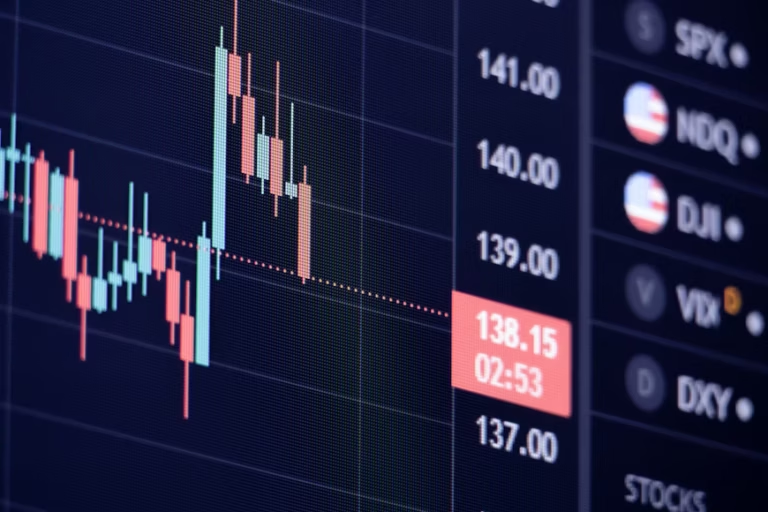
Artificial intelligence (AI) elevates the concept of technical analysis by its non-stop, automated chart pattern recognition, trend following and signal detection, in short, whatever the machine can do and the human might not see or overlook. Such platforms as TrendSpider and Trade Ideas benefit from AI in figuring out the exact points of breakout, levels of resistance, and the formation of the candlestick.
Whereas the customary indicator of the kind is still, AI has the ability to learn from the previous patterns and improve its precision gradually. This very feature of adaptation is what enables traders to be quicker in their decision-making as they rely on data only, thus the so-called brave work of trading in the scarcely liquid and rapidly moving markets is left for them.
12. Ethical and Data Privacy Concerns
Artificial intelligence is a compelling technology, however, its reliability is dependent on the quality of data it utilizes. Hence, investors should confirm that their AI tools obtain data from providers who are not only transparent but also ethical. In case of dependency on bad or manipulated data, it can result in false insights and bad investment decisions.
Moreover, the security of personal information plays an essential role. AI tools should be used at all times, which are in accordance with data protection regulations and provide privacy protection.
💡 Best Investment Tip :
Trust verified data sources — bad data equals bad investment outcomes. Reliability always beats speed.
13. Integrating AI Into Long-Term Wealth Planning
AI is not only a tool for daily trading. It is also capable of long-term financial planning, including retirement predictions and asset allocation. AI-powered tools assess your earnings, spending, risk tolerance, and objectives to come up with a tailored investment plan.
As an illustration, Wealthfront employs AI to run numerous simulations of a user’s financial situation to examine the effect of the varying market conditions on users’ future wealth. Investors gain confidence in their decisions because they have such kind of knowledge.
14. The Future of AI Investing
Artificial intelligence and finance are two sectors that are slowly being intertwined. Consequently, the investing ecosphere will be substantially altered by such far-off innovations as quantum computing, generative AI, and real-time behavioral analytics.
Maybe a little later, we will have AI advisors capable of live negotiations, accurately predicting market changes with a breathtaking level of precision, and even producing investment products that are individualized to each client.
Investors who will have the capability to modify their tactics, and keep themselves informed of the technological innovations, will be very muchwinningpersons.

Maximize Returns: 12 Ranked Passive Income Investments
15. Building a Balanced AI-Driven Strategy
The strongest investment approach is one that harnesses AI’s data-crunching ability and human intuition. Employ AI to handle research, trend detection, and optimization — however, make your understanding, experience, and goals decide the final call.
AI is like a co-pilot. It enables you to view further, quicker, and with more clarity — however, you are still the one holding the steering wheel. A disciplined, patient investor who uses AI tools in a prudent manner will be a winner in the market against both impulsive traders and those who choose to ignore technology.
💡 Best Investment Tip
AI is powerful — but discipline, patience, and continuous learning win every time.
Conclusion: Smarter Investing with a Human Touch
Artificial intelligence instruments have changed dramatically the methods with which investors have to deal with the market.
AI tools make the process of researching easy, they control risks and with the help of the data, they give you the chance to make good decisions. However, the human factor is still necessary. No computer program can substitute your decision-making, your insight, or your ability to see the big picture.
Incorporating AI will be the differentiating factor for tomorrow’s genius investors not only to have the skill of picking stocks. By effectively utilizing this partnership you are ahead of the trend – your investment strategy becomes not only smarter but also more resilient and equipped for the future.